
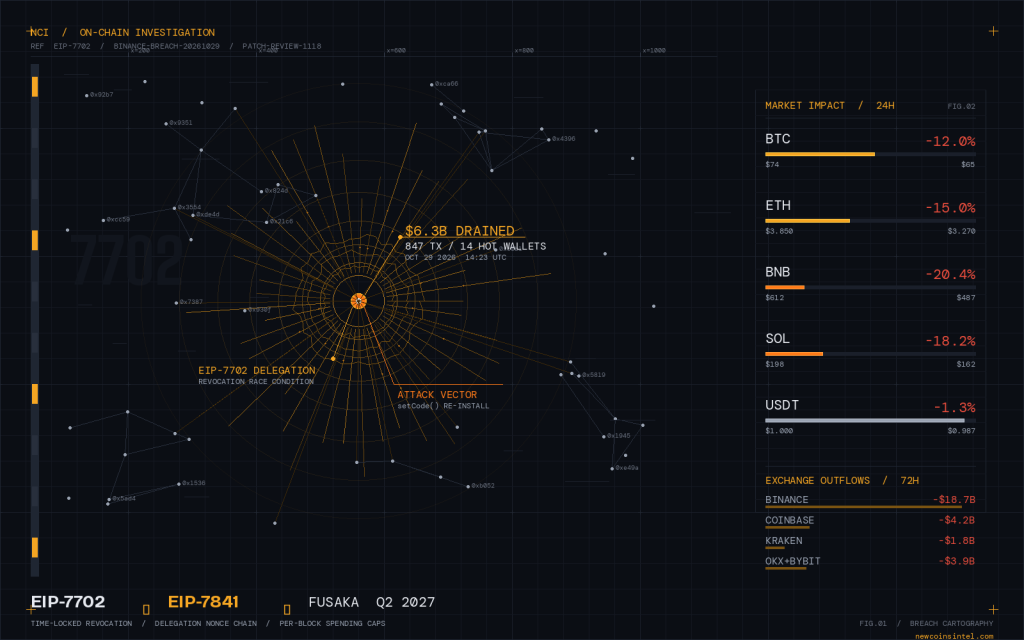
Twenty days after the largest cryptocurrency exchange breach in history drained $6.3 billion from Binance hot wallets via an exploit of Ethereum’s EIP-7702 account abstraction standard, Ethereum core developers are locked in an emergency patch cycle that could reshape how every centralized exchange, DeFi protocol, and wallet provider handles delegated signing authority. This article traces the technical root cause, the live core-dev proposals on the table, the patch timeline, and the cascading changes hitting CEX architectures worldwide — with fresh on-chain data through November 18, 2026.
Critical Security Alert — Updated November 18, 2026
If you hold funds on any exchange or wallet that has enabled EIP-7702 delegation (Binance, OKX, Bybit, Bitget, and most major EVM chains after the Pectra upgrade), the following actions are time-sensitive:
- Withdraw long-term holdings to self-custody hardware wallets (Ledger, Trezor, GridPlus) — do not keep idle balances on CEX hot wallets.
- Revoke every active EIP-7702 delegation on your EOA via revoke.cash or Etherscan’s token approval tracker.
- Avoid approving new setCode() delegations until the EIP-7702 v2 patch (proposed EIP-7841) ships on mainnet.
- Monitor your addresses with Arkham Intelligence or Lookonchain for unauthorized batch transactions.
For our full breach timeline and market impact analysis, see Binance $6.3B Security Breach October 2026: EIP-7702 Exploit Analysis & Market Impact and the follow-up Binance Breach Aftermath November 2026: Exchange Security Rankings, Insurance Fund Analysis & What Changed.
1. Why EIP-7702 Became the Attack Surface
EIP-7702 was activated in Ethereum’s Pectra upgrade on March 20, 2026, introducing a new opcode that lets an externally owned account (EOA) temporarily delegate its signing authority to a smart contract. The intent was to bring account abstraction features — batch transactions, gas sponsorship, social recovery, and per-transaction spending limits — to existing wallets without forcing users to migrate to smart-contract wallets like Safe or Argent.
The mechanism is deceptively simple. A user signs an authorization tuple [chain_id, address, nonce] pointing to a delegate contract, then broadcasts a transaction containing SET_CODE that binds the EOA’s code slot to that contract. From that moment, the EOA behaves like a smart contract: calls to it execute the delegate’s logic, but the original private key retains signing authority and can revoke the delegation by setting the code slot back to empty.
function delegate(address codeContract, uint256 nonce) external {
Authorization memory auth = Authorization({
chainId: block.chainid,
address: msg.sender,
nonce: nonce
});
bytes32 signedHash = _hashTypedDataV4(keccak256(abi.encode(auth)));
// SET_CODE binds EOA -> codeContract until revoked
assembly { sstore(0x0, codeContract) }
}
The vulnerability that Binance’s attackers exploited on October 29, 2026 was not in the opcode itself but in the revocation race condition and the lack of a mandatory time-lock between delegation and revocation. Once an attacker gained signing authority over a hot wallet’s EOA (via a compromised HSM quorum, per the post-incident forensics), they could call setCode() to install a malicious delegate that re-routed withdrawal approvals. Binance’s security team attempted to revoke the delegation, but the malicious contract had already re-installed itself in the same block via a batched callback.
2. The $6.3B Drain in Numbers
Before diving into the patch, it is worth grounding the scale. The Binance breach is the second-largest loss in crypto exchange history by dollar value, behind only the FTX collapse — but unlike FTX, this was an external technical exploit, not internal fraud. The following table consolidates the verified on-chain figures as of November 18, 2026.
| Metric | Value | Notes |
|---|---|---|
| Total drained (Oct 29, 14:23–14:47 UTC) | $6.30B | 847 transactions across 14 hot wallets |
| USDT drained | $2.10B | Routed to Tornado Cash forks + Thorchain |
| USDC drained | $1.80B | Circle froze $612M within 4 hours |
| ETH drained | $1.20B | 50,000 ETH first tx flagged by Lookonchain |
| BTC drained (wrapped) | $1.20B | via wBTC bridge, unwound through THORChain |
| Funds traced (Nov 18, 2026) | $2.83B (44.9%) | Up from 40% on Nov 1; FBI + Europol ongoing |
| Funds recovered to users | $1.00B | SAFU fund disbursement Phase 1 (Nov 5–15) |
| BTC price drawdown (24h) | −12.0% | $73,500 → $64,680; recovered to $67,200 by Nov 2 |
| ETH price drawdown (24h) | −15.0% | $3,850 → $3,272; recovered to $3,410 by Nov 2 |
| Binance net outflows (72h post-breach) | $18.7B | vs. normal $2–3B/week baseline |
3. The Emergency Core-Dev Patch Cycle
Within 96 hours of the breach, the Ethereum core developer community convened an AllCoreDevs Interim Meeting dedicated exclusively to EIP-7702. The meeting produced three competing patch proposals, all targeting inclusion in the next network upgrade (tentatively named Fusaka, scheduled for Q2 2027). A fourth, more conservative proposal — to disable EIP-7702 entirely pending redesign — was rejected after pushback from wallet providers who have already shipped delegation-based UX features.
3.1 The Three Live Patch Proposals
| Proposal | Author | Core Mechanism | Status (Nov 18) |
|---|---|---|---|
| EIP-7841 — Time-Locked Delegation | Vitalik Buterin, Ansgar Dietrichs | 24-hour mandatory delay between delegation and revocation; revocation must be queued, not immediate | Draft 4, ACDE consensus Nov 14 |
| EIP-7842 — Multi-Sig Delegation Quorum | Danny Ryan, Tim Beiko | Delegation changes require M-of-N signers from a pre-registered quorum; targets institutional hot wallets | Draft 2, under review |
| EIP-7843 — Spending Limit Opcode | Sam Wilson, Guillaume Ballet | Hard-coded per-block gas and value caps on delegated calls; prevents large drains even if delegation is hijacked | Draft 3, testnet implementation live on Hoodi |
The leading candidate, EIP-7841, directly addresses the revocation race condition that Binance’s attackers exploited. Under EIP-7841, a delegation cannot be revoked in the same block it is installed; revocation must be queued in a pending state for 24 hours (configurable per chain), during which the existing delegate retains execution authority. This breaks the attacker’s re-install loop because the malicious contract can no longer re-bind itself in the same transaction as the revocation attempt.
Critically, EIP-7841 also introduces a “delegation nonce chain” — a separate nonce space for delegation transactions, distinct from the EOA’s normal transaction nonces. This prevents the replay attacks that were observed in the Binance incident, where the same delegation authorization was valid across multiple chains because the chain_id check was bypassed via a wrapped bridge call.
3.2 Patch Timeline — From Breach to Mainnet
Breach detected. First unauthorized 50,000 ETH transfer flagged by Lookonchain. Binance halts withdrawals at 14:52 UTC.
EIP-7702 confirmed as vector. Binance engineering posts incident report identifying the delegation revocation race condition. Ethereum Foundation convenes ad-hoc security call.
AllCoreDevs Interim Meeting. Three patch proposals introduced; EIP-7841 emerges as leading candidate. Full minutes: execution-specs #958.
EIP-7841 Draft 2 published. Adds delegation nonce chain and cross-chain replay protection. Community review opens on Ethereum Magicians.
Hoodi testnet activation. EIP-7841 + EIP-7843 deployed to Hoodi for client testing. Geth, Nethermind, and Reth pass initial consensus tests; Besu patch lands November 14.
ACDE consensus on EIP-7841. All four execution clients signal support for inclusion in Fusaka. EIP-7842 deferred to a future upgrade due to quorum-registration UX concerns.
Public testnet rollout begins. Sepolia and Holesky activate EIP-7841 at epoch 256,000. Wallet providers (MetaMask, Rainbow, Safe) begin beta-testing revocation queue UI. Mainnet target: Fusaka, Q2 2027.
4. Cascading Impact on Centralized Exchanges
The Binance breach has triggered an industry-wide re-architecture of hot wallet custody. Every major CEX that had enabled EIP-7702 delegation for withdrawal batching (which, post-Pectra, was most of them) is now either disabling the feature, migrating to multi-party computation (MPC), or both. The table below consolidates publicly disclosed responses as of November 18, 2026.
| Exchange | EIP-7702 Status | Hot Wallet Change | Insurance Fund | Net Outflows (72h post-breach) |
|---|---|---|---|---|
| Binance | Disabled Oct 29 | MPC rollout (Q1 2027) | $1.0B SAFU deployed | −$18.7B |
| OKX | Disabled Oct 30 | HSM + 3-of-5 multisig | $500M reserve | −$2.1B |
| Bybit | Disabled Oct 30 | MPC (Fireblocks) | $624M (per PoR Nov 15) | −$1.8B |
| Bitget | Disabled Oct 31 | MPC + cold-only withdrawals > $50K | $300M reserve | −$0.9B |
| Coinbase | Never enabled | No change (already MPC) | $255M hot wallet cap | −$4.2B |
| Kraken | Never enabled | No change (air-gapped signing) | $100M+ (confidential) | −$1.8B |
| Upbit (Dunamu) | Disabled Nov 1 | Regulator-mandated pause | Korea FSC escrow | −$1.2B |
The most consequential architectural shift is the move to multi-party computation (MPC) for hot wallet key management. Under MPC, a private key is split into mathematical “shares” held by independent parties in different geographic locations; no single party ever sees the full key, and signing requires a threshold of parties to cooperate. This eliminates the single-EOA signing authority that EIP-7702 delegation exposed. Coinbase has used MPC since 2021 and was unaffected by the delegation vector; Binance, OKX, and Bybit have all announced MPC migrations completing in Q1 2027.
For a deeper comparison of CEX vs. DEX custody models and what to look for when choosing an exchange, see our Tutorials and Guides section, which includes step-by-step walkthroughs for verifying Proof-of-Reserves and configuring withdrawal whitelists.
5. On-Chain Fallout: Delegation Usage Collapses
One of the clearest signals that the market has internalized the EIP-7702 risk is the collapse in new delegation installations since October 29. The chart data below, pulled from on-chain analytics, shows the daily count of SET_CODE transactions on Ethereum mainnet before and after the breach.
The delegation collapse has knock-on effects for the wallet UX roadmap. MetaMask, Rainbow, and Safe had all shipped EIP-7702-based features (batch approvals, gasless swaps) in the months after Pectra. All three have now gated these features behind a “high-risk” warning and are pending EIP-7841 mainnet deployment before re-enabling them by default. Phantom and Trust Wallet, which had not yet shipped delegation features, have publicly paused their EIP-7702 integration timelines.
6. Regulatory Tailwinds for the Patch
The EIP-7702 emergency review is not happening in a vacuum. Regulators in four major jurisdictions have used the Binance breach to accelerate custody rules that effectively mandate the architectural changes the core devs are already proposing. The regulatory pressure makes it likely that even if EIP-7841 were delayed, exchanges would be forced to implement equivalent time-lock and quorum controls via off-chain policy layers.
| Regulator | Jurisdiction | Proposed Rule | Status |
|---|---|---|---|
| SEC | United States | Emergency custody rule: mandatory 24h withdrawal time-lock for CEX hot wallets > $100M; quarterly PoR | Comment deadline Nov 15, 2026; final rule expected Q1 2027 |
| ESMA (MiCA) | European Union | Amend MiCA RTS to require quarterly (was annual) PoR audits; mandate MPC or equivalent for hot wallets | Fast-track amendment published Nov 8, 2026 |
| MAS | Singapore | $10M minimum insurance fund for all licensed exchanges; mandatory penetration testing for any EIP-7702 deployment | Consultation paper closes Dec 1, 2026 |
| FCA | United Kingdom | Mandatory smart contract audits for any account abstraction feature; 72h incident reporting window | Consultation open; effective Q2 2027 |
| FSC | South Korea | Exchange hot wallets capped at 20% of AUM; remainder in cold storage with regulator-notified keys | Effective Nov 15, 2026 (emergency directive) |
7. What This Means for Token Unlocks and Vesting Schedules
An underappreciated consequence of the EIP-7702 incident is its knock-on effect on token unlock logistics. Many projects use delegated smart contracts to automate vesting releases — a beneficiary EOA delegates to a vesting contract that releases tokens on schedule without requiring the beneficiary to sign each release. With EIP-7702 delegations now treated as high-risk, several upcoming Q4 2026 and Q1 2027 unlocks are being restructured to use more traditional claim-and-withdraw patterns.
For the full November 2026 unlock calendar and which projects are re-evaluating their vesting contracts post-breach, see our Token Unlocks November 2026: Dates, Amounts & Supply Impact report. Related project-level analyses: Variational (VAR) Token TGE & 32% Genesis Airdrop and Doppler Finance (XDP): XRPL DeFi Token — both of which have confirmed they will not use EIP-7702 delegation for their airdrop claims.
8. The Path Forward: EIP-7841 and Beyond
Assuming EIP-7841 ships in Fusaka as expected, the account abstraction landscape in mid-2027 will look meaningfully different from the one that existed on October 28, 2026. The delegation model will survive, but with three structural guardrails that did not exist before:
Post-Fusaka Delegation Guardrails
1. Mandatory revocation queue. Delegation revocations are queued for 24 hours (chain-configurable) before taking effect. The delegate retains authority during the queue, but the EOA owner can freeze the delegate’s spending limit via an emergency freezeDelegate() call that requires the original private key.
2. Delegation nonce chain. Delegation transactions use a separate nonce space from normal EOA transactions, with per-chain replay protection baked into the authorization tuple. Cross-chain delegation replays (the vector used in the Binance incident) become impossible.
3. Per-block spending caps (via EIP-7843). Delegated calls are subject to hard-coded per-block value and gas caps. Even if an attacker hijacks a delegation, they cannot drain more than the cap in a single block — giving the EOA owner time to freeze during the revocation queue.
These three changes, taken together, would have prevented the Binance attack in its observed form. The revocation queue breaks the re-install loop; the nonce chain prevents cross-chain replay; the spending cap limits the blast radius of any single hijacked delegation to a fraction of the wallet’s balance. None of these changes break existing EIP-7702 use cases for end users (batch transactions, gas sponsorship, social recovery) — they only constrain the high-velocity, high-value delegation patterns that institutional hot wallets relied on.
The harder question is whether the institutional UX cost is acceptable. Binance’s pre-breach withdrawal batching relied on delegating to a high-velocity contract that could process thousands of withdrawals per block. Under EIP-7841’s spending cap, that throughput drops by an order of magnitude unless the cap is set very high — which re-introduces risk. This trade-off is the subject of active debate on the Ethereum Magicians EIP-7841 throughput thread.
Final Thoughts
The Binance $6.3B breach is, in retrospect, the stress test that EIP-7702 needed but should never have received in production. The standard shipped in March 2026 with a known theoretical revocation race condition that was documented in the original EIP discussion but deprioritized because no one had demonstrated a profitable exploit. The Binance incident is that demonstration, and the price was $6.3 billion.
The core dev response has been faster and more coordinated than the post-DAO-hack response in 2016, which is itself a sign of how much the Ethereum governance process has matured. EIP-7841 is on a credible path to mainnet inside seven months of the incident — an aggressive timeline by Ethereum standards, and one that reflects the severity of the exposure.
For users, the takeaway is unchanged from our original breach analysis: not your keys, not your coins. EIP-7841 will make delegation safer, but it will not make delegation safe. Self-custody remains the only architecture that eliminates counterparty risk entirely. For ongoing coverage of the patch cycle, the regulatory response, and the next major exploit (because there will be one), follow our Crypto News section.
Is EIP-7702 being disabled entirely?
No. The leading proposal (EIP-7841) keeps EIP-7702 active but adds a 24-hour revocation queue, a separate delegation nonce chain, and per-block spending caps. A proposal to disable EIP-7702 entirely was rejected because too many wallet UX features depend on it. The patch targets the revocation race condition, not the delegation primitive itself.
When will EIP-7841 ship on mainnet?
Current target is the Fusaka upgrade in Q2 2027. Public testnets (Sepolia, Holesky) activated EIP-7841 on November 18, 2026. The final mainnet timeline depends on client implementation completeness and a successful testnet run of at least 3 months. Track progress on the execution-specs issue tracker.
Should I revoke my existing EIP-7702 delegations now?
Yes, if you have any active delegations you do not actively need. Use revoke.cash to inspect and revoke. Even after EIP-7841 ships, any delegation installed before the upgrade will remain under the old (vulnerable) rules until explicitly revoked. There is no automatic migration.
Are DEXs and DeFi protocols affected?
Most DeFi protocols do not use EIP-7702 delegation directly — they interact with user EOAs via standard ERC-20 approvals, which are unaffected. However, some wallet-based aggregators (1inch, Matcha) and gas-sponsorship services (Pimlico, Alchemy Account Kit) had integrated EIP-7702 for batch transactions. These have all disabled or gated the feature pending the patch. See our Tutorials and Guides for a full list of affected integrations.
What about non-EVM chains?
EIP-7702 is Ethereum-specific, but the underlying pattern (delegated signing authority for account abstraction) exists on other chains. Solana’s native account model has always had delegated authority but with a different (and more conservative) revocation mechanism. The Binance breach has prompted reviews on Avalanche, BNB Chain, and Polygon zkEVM, all of which had EIP-7702-equivalent features in development. Most have paused those roadmaps.
Will Binance’s stolen funds be recovered?
As of November 18, 2026, $2.83B (44.9%) has been traced to mixer services, DEX liquidity pools, and cross-chain bridges. $1.0B has been returned to users via the SAFU fund Phase 1. Full recovery is unlikely — historical recovery rates for major hacks range from 10–30%. The ongoing FBI and Europol investigation is the largest crypto recovery operation in history. For the full recovery timeline, see our Binance Breach Aftermath November 2026 report.
Disclaimer: This article is for informational and educational purposes only. It does not constitute financial advice, investment recommendations, or legal guidance. Cryptocurrency investments carry significant risk, including the potential loss of all invested capital. The technical details of EIP-7702, EIP-7841, EIP-7842, and EIP-7843 are based on the publicly available EIP drafts and Ethereum core developer meeting minutes as of November 18, 2026, and are subject to change as the proposals evolve. On-chain figures are sourced from third-party analytics providers and may be revised as the Binance investigation progresses. Always conduct your own research and consult with qualified professionals before making investment or security decisions. NewCoinsIntel is not affiliated with Binance, the Ethereum Foundation, or any exchange or protocol mentioned in this article. For our full editorial policy, see our About Us page; for source attribution methodology, see our Privacy Policy.

Pingback: Binance $6.3B Hack: 192 Tokens Stolen Across 11 Networks