
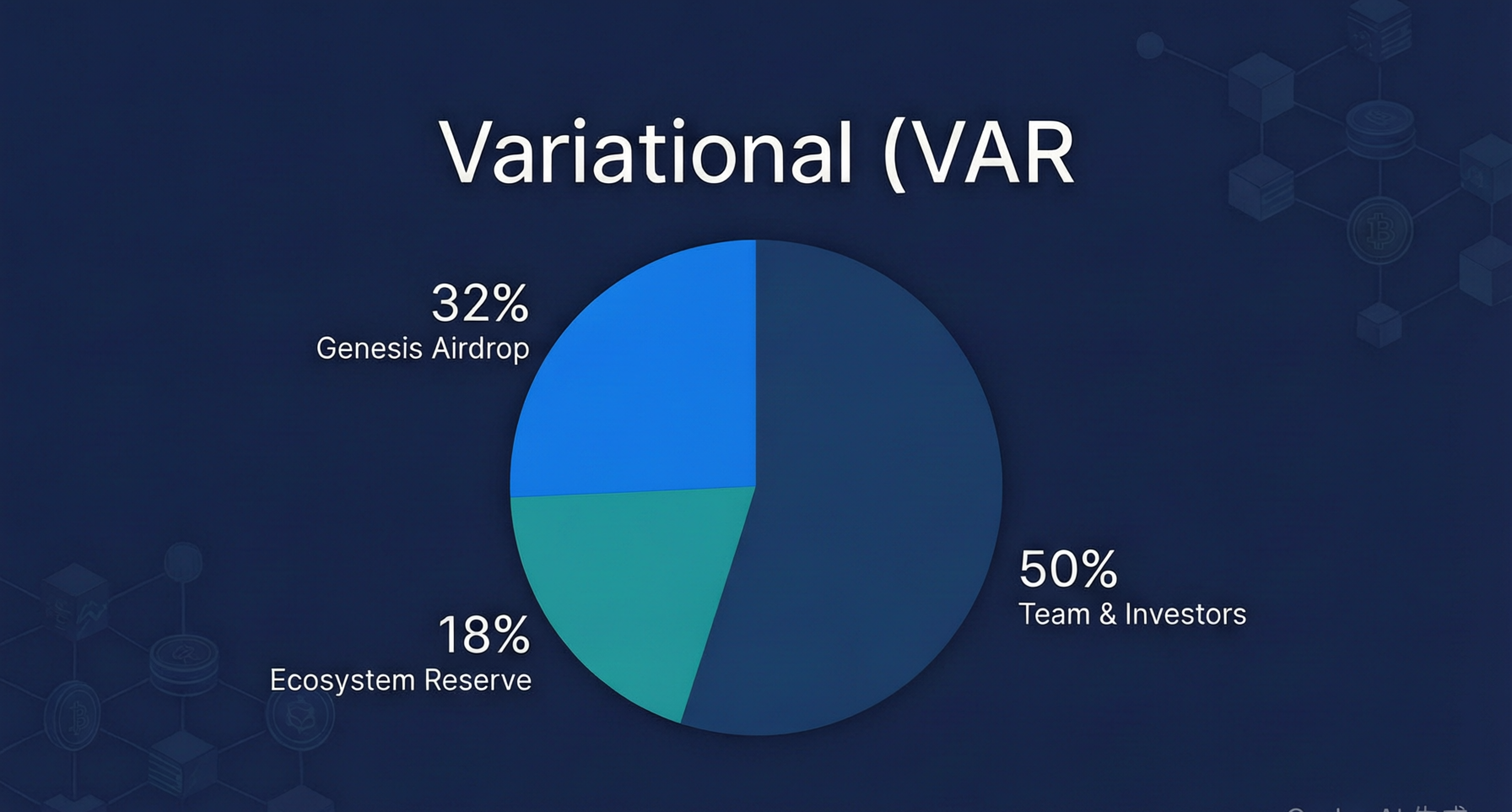
Variational is a decentralized perpetual futures trading protocol built on Hyperliquid. On September 24, 2026, the team officially published its tokenomics and airdrop plan, confirming that the VAR token generation event (TGE) will take place in Q4 2026 with 32% of total supply allocated to a genesis airdrop — fully unlocked at launch.
For anyone researching VAR now, the key questions are how the 32% airdrop is distributed, what the points-to-token conversion looks like, how the team and investor allocations are structured, and what risks exist when the first year of circulating supply consists almost entirely of airdrop tokens.
What Is Variational?
Variational is a decentralized perpetual futures DEX built on Hyperliquid’s EVM-compatible Layer 1. The protocol allows users to trade perpetual contracts with on-chain settlement, positioning it in the same category as protocols like Hyperliquid’s native perpetuals exchange, but as a separate application layer.
The project has raised significant venture capital backing. Its Series A round of $50 million was led by Dragonfly Capital, with participation from Bain Capital Crypto and Coinbase Ventures. An earlier seed round of $10.3 million was led by Bain Capital Crypto. This brings the total disclosed funding to approximately $60.3 million.
That funding history matters when evaluating VAR. The token is being introduced by a project with institutional backing and an existing product, rather than a concept-stage protocol. However, venture funding does not guarantee token performance, and the backing of well-known firms should be weighed alongside tokenomics structure and market conditions.
Readers comparing perp DEX projects can also explore NewCoinsIntel’s token launch coverage for additional research on TGE events, tokenomics and emerging blockchain ecosystems.
VAR Tokenomics: Supply, Allocation and Vesting
Variational’s official tokenomics announcement, published on September 24, 2026, divides the VAR token supply into three categories at TGE:
| Allocation Category | Share of Total Supply | Unlock Terms |
|---|---|---|
| Genesis Distribution (Airdrop) | 32% | 100% unlocked at TGE, distributed proportionally to points holders |
| Ecosystem Reserve | 18% | Managed by Variational Foundation for ecosystem growth |
| Team & Investors | 50% | Locked 12 months post-TGE, then linear vesting over at least 3 years |
The 32% genesis airdrop is the standout figure. It represents one of the largest community allocations among perp DEX protocols launching in this cycle, and it follows the precedent set by Hyperliquid’s own generous community distribution. The airdrop tokens are fully unlocked at TGE, meaning recipients can trade or transfer them immediately.
The team and investor allocation of 50% is locked for 12 months after TGE, then vests linearly over at least 3 years. This means that during the first year, no team or investor tokens will enter circulation.
VAR Points Program: How the Airdrop Is Distributed
Variational uses a points-based system to determine airdrop allocations. Users earn points through trading activity on the protocol, and the genesis airdrop will be distributed proportionally based on each user’s share of total points at the time of TGE.
Key details of the points program:
- Minimum eligibility: Users must hold at least 1 point to qualify for the genesis airdrop.
- Points accrual rate: 150,000 new points are distributed per week until TGE.
- Extension: The points program was originally scheduled to end in Q3 2026 but was extended through TGE due to what the team described as a “major strategic partnership.”
- Conversion rate: The exact points-to-token conversion rate is not yet determined, because the total points pool continues to grow until TGE occurs.
- Unclaimed tokens: Any airdrop tokens that are not claimed will be burned.
The fact that the conversion rate depends on the final total points pool is important. As more points are issued each week, the denominator grows, which means each individual point’s share of the 32% allocation decreases over time. This creates a dynamic where later participants receive a smaller proportional share than earlier ones, even though the absolute number of points earned per week remains constant.
How to check your VAR eligibility
If you have been actively trading on Variational, you should have accumulated points. The project has stated that users with at least 1 point will be eligible to sign the VAR claim terms and receive the genesis airdrop. Monitor the official Variational channels for the exact claim mechanism, which will be published closer to TGE.
Variational’s Revenue Model and Token Buyback
Beyond the airdrop allocation, Variational has committed to directing 100% of protocol revenue (sent to the Treasury) toward buying back and burning VAR tokens. This revenue-sharing model is designed to create a connection between protocol usage and token value over time.
The buyback-and-burn mechanism is similar to the approach used by Hyperliquid, which has set a high standard for community-friendly tokenomics in the perp DEX category. However, the actual impact of this mechanism depends on several variables:
- The volume of trading activity on the protocol, which determines revenue
- The fee structure and net revenue margin after operational costs
- Market conditions and liquidity available for buyback execution
- Whether the buyback volume is meaningful relative to the circulating supply
At this stage, Variational’s trading volume and revenue figures have not been publicly disclosed in a way that allows independent verification. Users should treat the buyback commitment as a stated intention rather than a guaranteed source of token demand.
VAR TGE Timeline: What We Know
| Date | Milestone | What It Means |
|---|---|---|
| Seed round (date undisclosed) | $10.3M seed funding | Led by Bain Capital Crypto |
| Series A (date undisclosed) | $50M Series A funding | Led by Dragonfly Capital, with Bain Capital Crypto and Coinbase Ventures |
| September 24, 2026 | Official tokenomics announcement | 32% genesis airdrop, 18% ecosystem, 50% team/investors confirmed |
| Q4 2026 (exact date TBD) | VAR TGE | Genesis airdrop distributed, 100% unlocked; trading expected to begin |
| Q4 2026 + 12 months | Team/investor unlock begins | 50% of supply begins linear vesting over 3+ years |
The TGE and exchange listing are separate milestones. A TGE refers to the creation and initial distribution of a token, while exchange listings determine when users can deposit, withdraw or trade it on specific platforms. The exact TGE date within Q4 2026 has not been announced. Exchange listing schedules will follow the TGE and may vary by platform.
Polymarket’s Implied FDV for VAR
Before the official tokenomics announcement, Polymarket hosted a prediction market for “Variational’s FDV one day after launch.” The market’s probability distribution provided one of the few public pricing signals for VAR.
Community analysts used the Polymarket data to model two valuation scenarios. While the exact numbers depend on the total points pool at TGE (which is still growing), some KOL estimates suggested that at a $1.5 billion FDV, individual points could be worth approximately $100 each. At a $3 billion FDV, the per-point value would be higher. These are estimates based on prediction market data, not official valuations, and the actual FDV will be determined by market trading after TGE.
What Could Drive VAR Demand?
Trading volume on the protocol
The strongest case for VAR depends on whether trading activity on Variational grows sufficiently to generate meaningful revenue for the buyback-and-burn mechanism. More volume means more fees, which means more buyback pressure. However, the perp DEX space is competitive, and Variational must compete with established protocols for liquidity and traders.
The 32% community allocation
A large airdrop creates a broad base of token holders who may become long-term users if the product delivers value. The 32% allocation signals that the team is prioritizing community distribution over insider allocation, which aligns with the post-Hyperliquid expectations for perp DEX tokenomics.
Hyperliquid ecosystem growth
Variational is built on Hyperliquid’s EVM. If the broader Hyperliquid ecosystem grows — more users, more liquidity, more applications — Variational could benefit from the network effects. However, this is an indirect dependency, and Hyperliquid’s own trajectory is not guaranteed.
Token distribution and vesting dynamics
With 50% of supply locked for 12 months, the first year’s circulating supply is relatively constrained beyond the airdrop. This could support price stability if demand is sufficient, but it also means that airdrop recipients bear the initial selling pressure without locked supply acting as a counterbalance.
Risks to Understand Before Buying VAR
Token utility risk: The buyback-and-burn mechanism depends on protocol revenue, which depends on trading volume. If volume is lower than expected, the buyback may not generate meaningful demand.
Points dilution: The points program continues until TGE, with 150,000 new points issued weekly. The longer the TGE is delayed, the larger the total points pool becomes, and the smaller each point’s share of the 32% allocation.
Smart contract and operational risk: Perp DEX protocols involve complex smart contracts, liquidation engines, oracle dependencies and margin systems. Vulnerabilities in any of these components can lead to losses.
Market and liquidity risk: Newly launched tokens may have volatile prices, limited market depth and substantial slippage. A large airdrop allocation can amplify these effects if many recipients sell simultaneously.
Competitive risk: The perp DEX category includes well-established protocols with deep liquidity and large user bases. Variational must differentiate itself to attract and retain traders.
Roadmap execution: The project has mentioned plans to end private testing, launch on the Omni public mainnet, expand trading features and release a trading API. These are planned milestones, not completed products.
None of these risks means VAR must perform poorly. They explain why project research should include product adoption data, token distribution analysis, technical documentation and market conditions rather than relying on the airdrop allocation percentage alone.
Frequently Asked Questions
When is the Variational VAR TGE?
Variational has confirmed that the VAR TGE will occur in Q4 2026, but no specific date has been announced. The 32% genesis airdrop will be distributed proportionally to points holders, with 100% of airdropped tokens unlocked at TGE. Monitor official Variational channels for the exact date.
How do I qualify for the VAR airdrop?
You need at least 1 point in your Variational account to be eligible for the genesis airdrop. Points are earned through trading activity on the protocol. The points program continues at 150,000 points per week until TGE. Unclaimed tokens will be burned.
What is the VAR token allocation?
The VAR token is allocated as follows at TGE: 32% genesis airdrop (100% unlocked), 18% ecosystem reserve (managed by foundation), and 50% team & investors (locked 12 months, then vesting over 3+ years).
What is the points-to-token conversion rate?
The exact conversion rate has not been determined yet. It will depend on the total number of points issued by the time TGE occurs. Because 150,000 new points are issued weekly until TGE, the total pool continues to grow. The 32% airdrop allocation is divided proportionally among all points holders.
Who backed Variational?
Variational raised $50 million in Series A funding led by Dragonfly Capital, with Bain Capital Crypto and Coinbase Ventures participating. An earlier seed round of $10.3 million was led by Bain Capital Crypto. Total disclosed funding is approximately $60.3 million.
What chain is VAR built on?
Variational is built on Hyperliquid’s EVM-compatible Layer 1 blockchain. VAR will be deployed on this network at TGE.
Track VAR Beyond the Announcement
VAR’s next phase depends on more than the airdrop allocation. Watch the exact TGE date, circulating supply at launch, trading volume on the protocol, and delivery of planned features to build a more complete view of the project.
Follow more token launches and project developments through NewCoinsIntel and explore our Crypto News section for additional research.
Data Sources
| Source | Information Used | Link |
|---|---|---|
| Variational official tokenomics announcement | 32% genesis airdrop, allocation structure, vesting terms, points program extension | PANews report |
| Variational airdrop analysis (Odaily) | Polymarket FDV modeling, points-to-token estimates, buyback mechanism details | Odaily via laohu8 |
| Variational 32% airdrop deep-dive | Token distribution analysis, first-year float risk, Hyperliquid comparison | Bitpush News |
| CoinW Research Weekly (Oct 5–11, 2026) | Predict.fun and FLOP Network context, broader Q4 TGE landscape | PANews CoinW report |
Disclaimer: This article is for informational and educational purposes only and does not constitute investment advice. Token allocations, TGE timelines, points-to-token conversion rates and market conditions can change. Always verify current data independently through official project sources before making any decision.

Pingback: Binance $6.3B Security Breach October 2026 | NewCoinsIntel