
Decoding Circle’s Arc Mainnet Launch: A Crypto Veteran’s Unfiltered Take on Wall Street’s New L1
If you’ve been in the trenches of crypto long enough, you develop a healthy cynicism toward every new Layer 1 blockchain that promises to “fix finance.” For years, we’ve watched sovereign chains launch with high-flying native utility tokens, aggressive inflation schedules, and empty promises of institutional adoption, only to turn into ghost towns once the incentive subsidies run dry.
So when Circle officially flipped the switch on Arc—its new USDC-native Layer 1 blockchain—my initial reaction was skepticism. Another L1? Do we really need one more execution environment clogging our dashboards? But as I dug past the marketing fluff and looked at the actual architecture, validator lineup, and early traction metrics, my perspective shifted. This isn’t just another VC-funded retail casino. This is TradFi setting up its own digital playground.
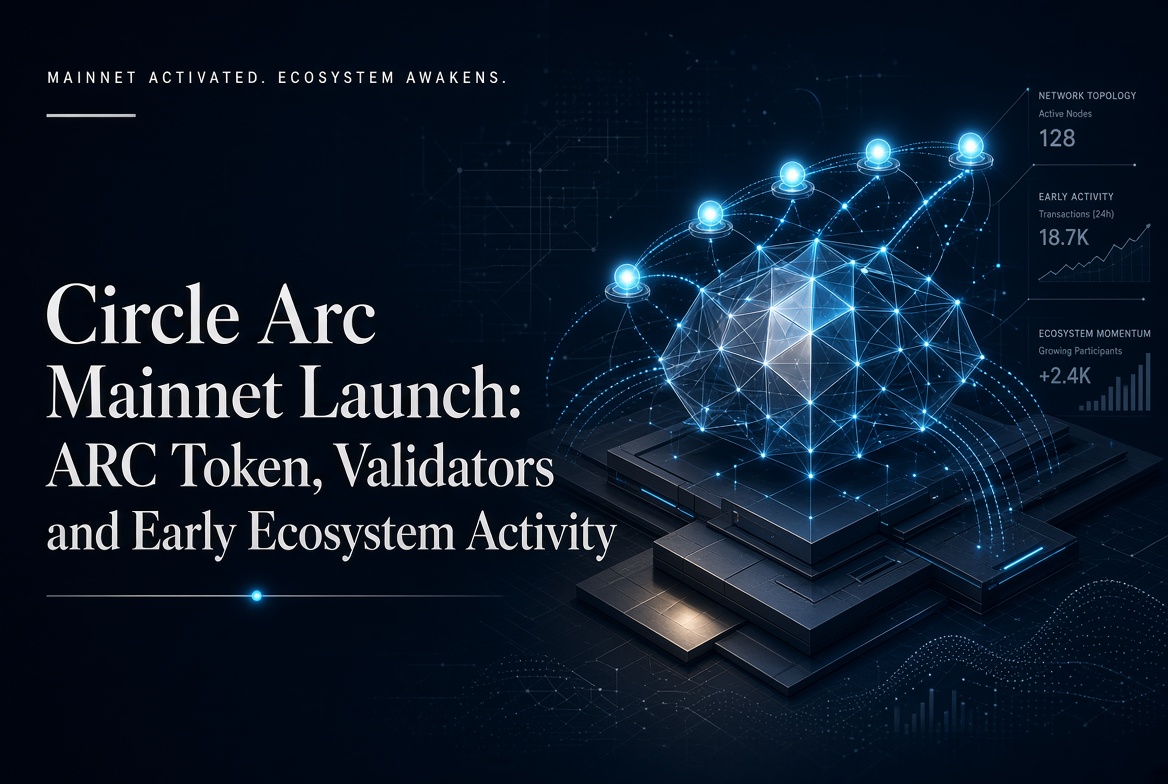
1. What Exactly is Arc? The Architecture Breakdown
At its core, Arc is a fully EVM-compatible Layer 1 blockchain built explicitly around a singular economic premise: transactions settle in USDC instead of a volatile native gas token.
Let that sink in for a moment. If you’ve been trading or building on EVM chains like Ethereum or Arbitrum, you know the friction of keeping a separate volatile asset (ETH) just to pay for gas overhead. Arc eliminates that friction entirely. You bridge USDC in, and you spend USDC for gas—targeting a predictable base fee near $0.01 per transaction with sub-second, deterministic finality.
From a veteran trader’s lens, this solves a massive UX bottleneck. But what makes Arc truly dangerous (in a good way) isn’t just the gas token choice; it’s the backing. The network went live with a permissioned Proof-of-Authority (PoA) validator set featuring names that usually run global clearing houses rather than consensus nodes: **BlackRock, Visa, Mastercard, DTCC, ICE, and Standard Chartered**. Circle is planning a transition to Proof of Stake (PoS) in 2027, but right now, this is essentially Wall Street validating its own high-speed settlement rails.
The Numbers Don’t Lie: In its first week following the mid-September 2026 mainnet debut, Arc pulled in roughly $1 billion in total value locked (TVL), generating about $500,000 in fees and hitting a $3 billion fully diluted network valuation right out of the gate. That velocity of capital deployment is virtually unprecedented for a freshly launched L1.
2. Decoding the 10 Billion ARC Tokenomics
Naturally, the elephant in the room for any crypto native is the token. The genesis block completed a mint of 10 billion ARC tokens. However, Circle has been very careful to clarify that the genesis mint does not mean a public token launch is happening immediately.
Earlier in the year, Circle raised over $200 million via private token allocations to institutional backers at a $3 billion valuation. Here is how the token mechanics are structured:
- Gas is NOT Paid in ARC: Unlike traditional chains where the native coin is burned for gas, ARC functions strictly as a coordination mechanism for network security, future governance, and utility. All execution fees stay firmly denominated in USDC.
- The Allocation Split: Roughly 60% of the 10 billion supply is earmarked for “network participants” and ecosystem growth, leaving speculators anxiously waiting for official distribution guidelines.
- A Word of Caution: Because of the hype surrounding the token, unofficial pre-market bridges and speculative secondary pools saw wild premiums ahead of launch. If you’re looking at random airdrop checker links or unofficial claims platforms floating around social media right now, treat them with extreme suspicion—most are phishing vectors trying to drain wallets.
3. Day-One Apps and the “Agentic Economy” Narrative
Most L1s launch with empty blocks and a couple of fork-paste decentralized exchanges (DEXs). Arc took a drastically different approach, launching with more than 100 live applications and institutional integrations on day one. We are talking about heavy-hitters like Aave, Uniswap, Morpho, and major custody providers alongside traditional banking giants like HSBC and BNP.
More importantly, listen to what Circle CEO Jeremy Allaire keeps emphasizing: **Arc is built for the “Agentic Economic Era.”** With the explosion of AI agents executing automated financial workflows, micro-transactions, and programmatic FX trades via tools like Circle’s Agent Stack, automated systems require a blockchain that doesn’t expose them to volatile gas assets. Over 98% of agent-driven transaction volume on Circle’s framework currently settles in USDC. Arc provides a dedicated native playground where machine-driven capital can move instantly without worrying about gas price spikes during market volatility loops.
4. Strategy for Crypto Natives: How to Play Arc Without Getting Wrecked
As someone who has navigated multiple market cycles, my advice for approaching a walled-garden, institutionally backed chain like Arc is to separate your macro excitement from tactical greed:
- Respect the Liquidity Curve: Volume always hits a new chain before deep liquidity does. Early DEX yields and meme-asset bonding curves on Arc look staggering, but impermanent loss and thin order books will chew up unmanaged capital.
- Watch the Institutional Pilots: The real alpha on Arc isn’t retail degen trading—it’s watching how traditional asset managers deploy tokenized treasuries (like BlackRock’s BUIDL equivalents or yield-bearing products) onto the network rails. When institutional collateral mobility scales, the secondary effects on DeFi lending markets on Arc will be massive.
- Prioritize Security: Bridge only through official, audited routes like Circle’s Cross-Chain Transfer Protocol (CCTP) extensions. Avoid sketchy third-party wrappers trading at weird premiums.
Arc marks a maturation point for the crypto industry. We are moving away from pure ideological anarchy toward regulated, high-performance financial infrastructure. Whether you love or hate the institutional fingerprints all over it, ignoring a chain backed by BlackRock and Visa processing native digital dollars at sub-second speeds is a luxury serious market participants cannot afford.
