
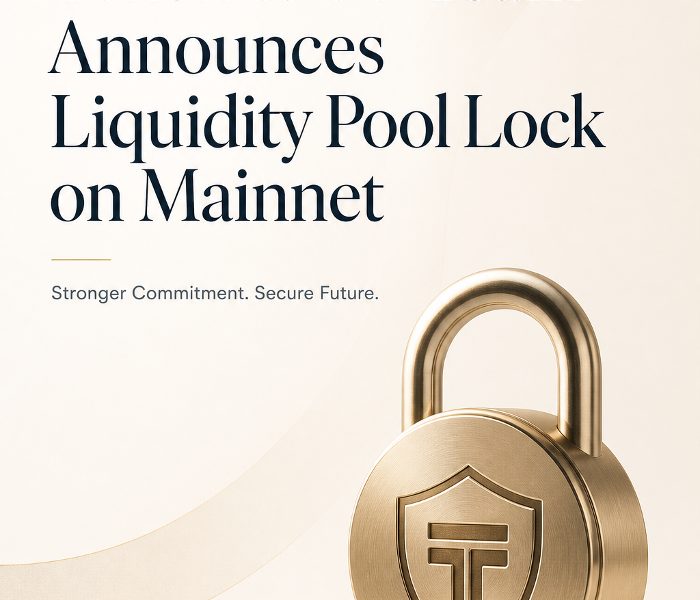
The team behind Token6900 (T6900) has announced that it completed a mainnet liquidity lock for its initial decentralized exchange liquidity pool. According to the project’s public communications, the measure was introduced as a security and transparency initiative designed to reduce the risk of sudden liquidity withdrawals and provide additional confidence for participants trading the token.
However, a liquidity lock announcement alone does not confirm the overall security of a cryptocurrency project. Independent verification of the lock transaction, locker provider, unlock conditions, smart contract permissions, and token distribution remains necessary before investors can evaluate the broader risk profile of the asset.
A locked liquidity pool can reduce one specific risk category — the possibility of developers immediately removing exchange liquidity — but it does not guarantee that a token is secure, fairly distributed, or free from other smart contract and governance risks.
What a Mainnet Liquidity Lock Means for Token6900 Holders
Liquidity locks are commonly used by decentralized finance (DeFi) projects to restrict access to Liquidity Provider (LP) tokens after adding assets to an automated market maker (AMM) pool. When LP tokens are transferred into a time-lock contract, the project team cannot immediately withdraw the paired assets from the liquidity pool until the lock period expires or specific conditions are met.
For early-stage tokens such as Token6900, liquidity locking is primarily intended to address concerns surrounding liquidity removal events, often referred to as “rug pulls.” By preventing unrestricted access to LP tokens, projects can demonstrate a higher level of commitment to maintaining market liquidity during the initial trading phase.
- LP token deposit transaction on a public blockchain explorer
- Verified liquidity locker contract address
- Lock duration and unlock timestamp
- Ownership and administrator permissions
- Token holder concentration and wallet distribution
Smart Contract Security and Independent Verification Status
The Token6900 team has stated that the liquidity lock was executed through a verifiable smart contract mechanism. However, publicly available information should be independently checked against blockchain records, including the actual lock transaction hash, contract address, and third-party locker verification page.
A liquidity lock does not directly evaluate other important security factors, including whether the token contract contains privileged functions, whether additional tokens can be minted, whether ownership controls remain active, or whether developer wallets maintain significant concentrated holdings.
At the time of review, publicly accessible materials did not provide independently confirmed details regarding the specific liquidity locker contract, lock duration, blockchain transaction hash, or a complete third-party security audit covering the entire Token6900 smart contract system.
Commercial Structure and Governance Disclosure
The liquidity lock announcement did not disclose new venture capital investment, institutional partnerships, acquisition agreements, or changes in project ownership structure. The action represents an operational security measure related to decentralized exchange liquidity management rather than evidence of external financial backing.
No public disclosures reviewed for this report identified shared ownership arrangements, formal joint ventures, or commercial agreements between Token6900 and major cryptocurrency exchanges, custodians, or blockchain infrastructure providers.
Market Context and Risk Considerations for Investors
Liquidity security has become a major evaluation factor for investors participating in early-stage token launches, particularly within meme-token and community-driven markets. Blockchain investigators such as ZachXBT have previously highlighted risks across the cryptocurrency industry involving anonymous teams, concentrated token ownership, suspicious wallet movements, and insufficient transparency around project finances.
While a confirmed liquidity lock can address one specific concern related to immediate liquidity withdrawal, it does not eliminate broader market and technical risks. Investors evaluating Token6900 should independently review smart contract permissions, wallet concentration, liquidity structure, audit documentation, and official project channels before making investment decisions.
The liquidity lock announcement provides a positive transparency signal if independently verified. However, no liquidity lock should be considered a guarantee against smart contract vulnerabilities, market manipulation, token concentration risks, or project execution failures.
