
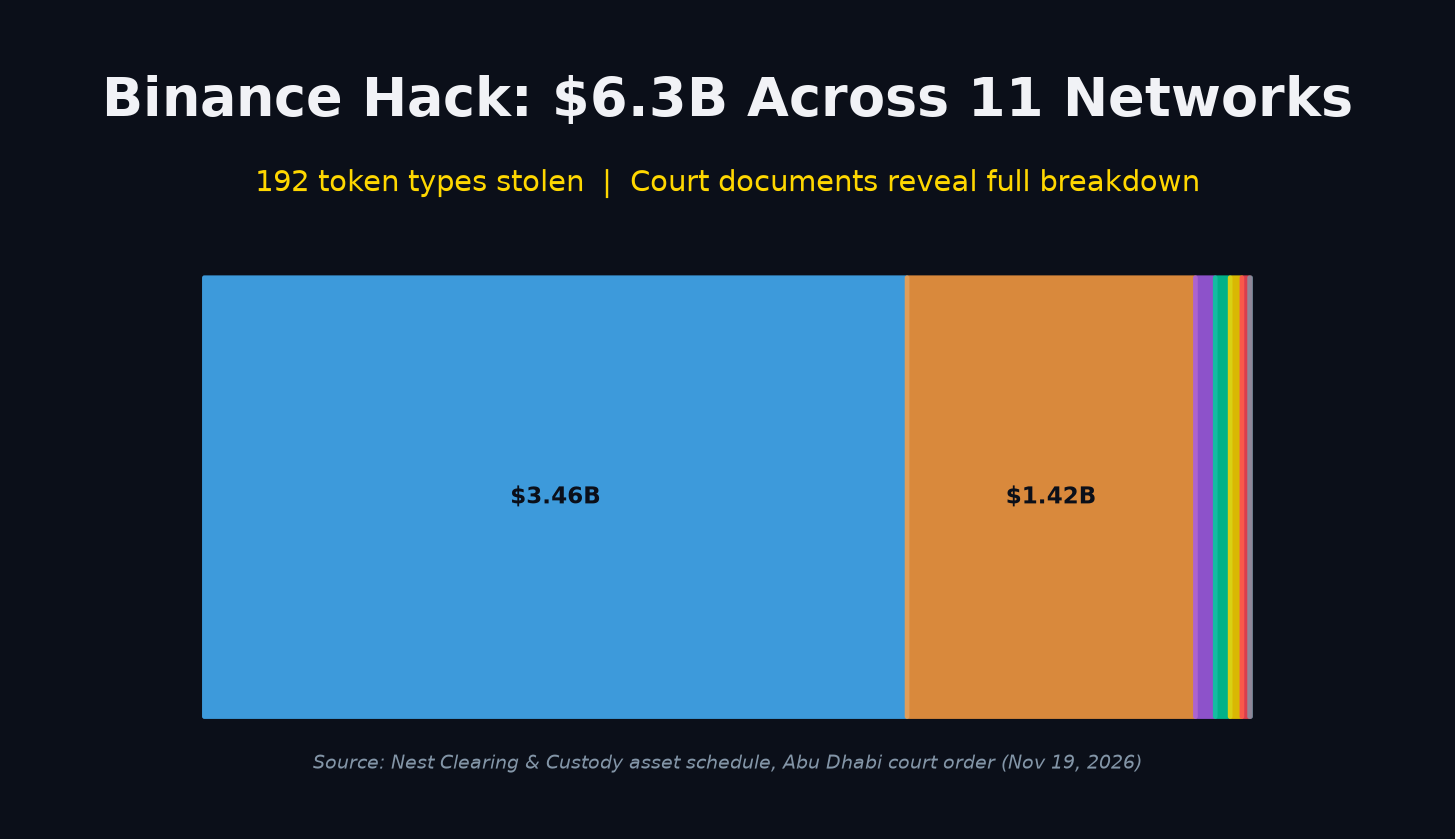
Court documents filed in Abu Dhabi on November 19, 2026 have revealed the full scope of the record-breaking $6.3 billion Binance hack: attackers stole 192 distinct cryptocurrencies across 11 blockchain networks, with fiat-linked stablecoins accounting for more than half the stolen value.
The asset schedule, submitted by Nest Clearing and Custody Limited — the entity that operated the affected Binance wallets — provides the first complete breakdown of every token type, quantity, and dollar value at the time of the October 29 theft. Earlier reporting from our initial coverage of the Binance $6.3B security breach identified the exploit vector; these new filings show where the money actually went.
What’s in this article
Key figures at a glance
The numbers from the court filing are stark. This was not a targeted extraction of a few high-value assets — it was a sweep of every liquid token in the compromised wallets, across every chain those wallets touched. The 192 figure matters because it shows the attackers optimized for breadth, not selectivity, which has direct implications for how recovery is being pursued.
| Asset category | Amount stolen | Share of $6.3B |
|---|---|---|
| Fiat-linked stablecoins (11 types) | $3.46B+ | 55% |
| Bitcoin (BTC) | $1.42B | 22.5% |
| USDC | $826M | 13.1% |
| DeFi tokens (UNI, ENA, AAVE) | $97.4M | 1.5% |
| Wrapped Beacon ETH (WBETH) | $73.5M | 1.2% |
| Tokenized gold | $58M | 0.9% |
| Memecoins (PEPE, SHIB, others) | $37.9M | 0.6% |
| Gaming & metaverse tokens | $5M+ | 0.1% |
The top three tokens: 76% of the haul
Three assets made up roughly 76% of the total stolen value: Tether’s USDT at $2.50 billion, Bitcoin at $1.42 billion, and Circle’s USDC at $826 million. The concentration in these three is not accidental — they are the deepest, most liquid markets in crypto, which means they were the largest positions held on any major exchange’s operational wallets.
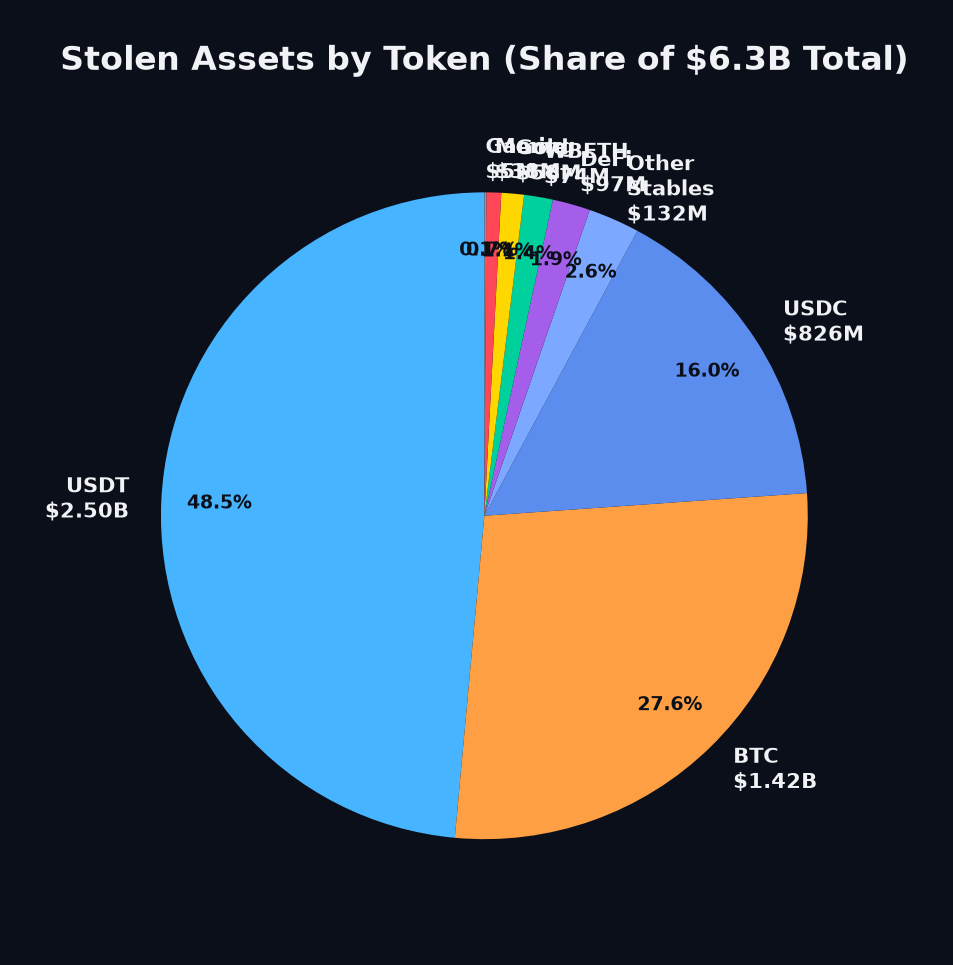
Stolen assets by token type. USDT alone accounted for nearly 40% of the $6.3B total.
The USDT figure is particularly significant. At $2.50 billion, it represents the single largest stablecoin theft in history by a wide margin — the previous record was the $615 million Ronin Network bridge exploit in March 2022. The fact that Tether can freeze issuer-level addresses on the Ethereum and Tron versions of USDT is one reason recovery prospects for this portion are better than for native BTC, which has no such freeze capability at the protocol level.
Sources: USDT, BTC, and USDC figures from Nest Clearing asset schedule (Cointelegraph, Nov 19, 2026). Historical stablecoin theft comparison from Rekt Database and Chainalysis Crypto Crime reports.Why stablecoins dominated (55% of total)
Fiat-linked stablecoins accounted for at least $3.46 billion — 55% of everything stolen. Beyond USDT and USDC, the court schedule lists nine additional stablecoins:
| Stablecoin | Issuer | Network |
|---|---|---|
| RLUSD | Ripple | XRP Ledger |
| USD1 | World Liberty Financial | Ethereum |
| USDE | Ethena | Ethereum |
| FDUSD | First Digital | BNB Chain / Ethereum |
| USDS | Sky (formerly MakerDAO) | Ethereum |
| XUSD | StraitsX | Ethereum |
| BUSD | Binance (deprecated) | Ethereum / BNB Chain |
| USDP | Paxos | Ethereum |
| EURI | Eurite | Ethereum |
These nine stablecoins were worth a combined $132.4 million at the time of the theft. The stablecoin dominance has a structural reason: Binance’s operational wallets held large stablecoin reserves for user withdrawals and market-making across multiple chains, and the EIP-7702 exploit that enabled the hack gave attackers signing authority over all of them simultaneously. For the technical details of how EIP-7702 was abused, see our analysis of the EIP-7702 emergency patch and account abstraction vulnerability.
Sources: Stablecoin list and combined value from Abu Dhabi court asset schedule. EIP-7702 exploit vector documented in NewCoinsIntel technical analysis and confirmed by CoinDesk (Oct 29, 2026).The long tail: memecoins, gold, gaming, DeFi
What makes the 192-token figure remarkable is the long tail of smaller positions the attackers swept along with the major holdings. These are not amounts that move markets, but they show the attackers did not cherry-pick — they took everything the compromised wallets could sign for.
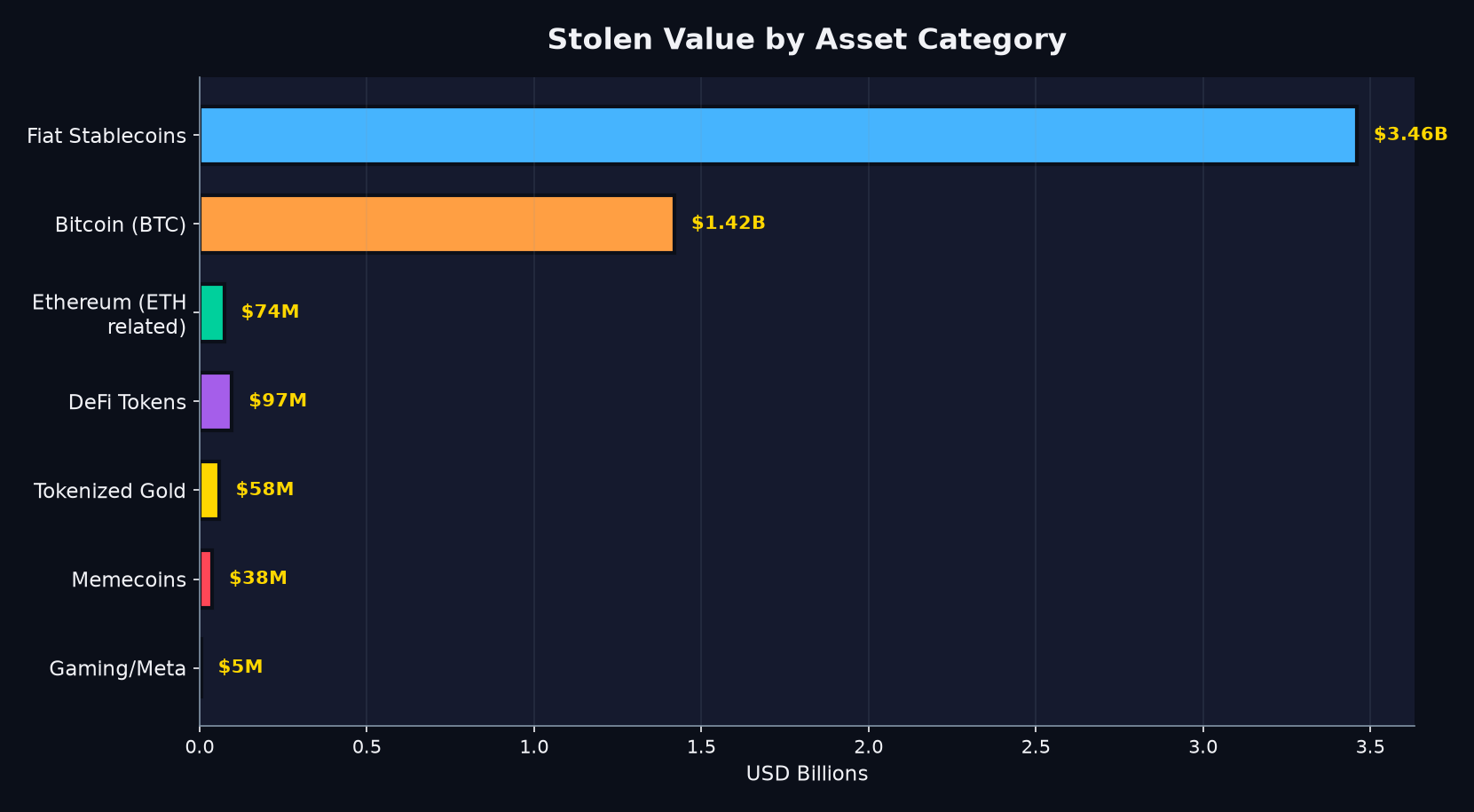
Stolen value by asset category. The gap between stablecoins and everything else is vast.
Memecoins: $37.9 million
Led by $34.9 million in Pepe (PEPE) and $2.3 million in Shiba Inu (SHIB). These positions reflect meme token liquidity that Binance maintained for its spot trading pairs. The PEPE figure is notable because it represents one of the largest single meme-coin losses on record, though it is a rounding error against the $6.3B total.
Tokenized gold: $58 million
The court schedule lists $58 million in tokenized gold products. This category typically includes tokens like Tether Gold (XAUt) and Paxos Gold (PAXG), each backed by physical gold held in vaults. Tokenized gold is an increasingly visible part of exchange reserves as traders use it for inflation hedging without exiting crypto rails.
Gaming and metaverse: $5 million+
At least $5 million across five gaming and metaverse tokens, including The Sandbox (SAND), Axie Infinity (AXS), and Decentraland (MANA). These are legacy positions from the 2021-2022 metaverse cycle that apparently remained on Binance’s books.
DeFi blue chips: $97.4 million
Three DeFi governance tokens were taken: $45.1 million in Uniswap (UNI), $37.3 million in Ethena (ENA), and $15.1 million in Aave (AAVE). These are tokens Binance held as treasury or for staking-yield products, not customer custody positions — which means their loss hits Binance’s own balance sheet rather than user accounts.
Wrapped Beacon ETH: $73.5 million
$73.5 million in Wrapped Beacon ETH (WBETH) was stolen. WBETH is Binance’s liquid staking wrapper for beacon-chain ETH, and its presence in the haul indicates the compromised wallets had staking-related operations, not just spot trading custody.
Sources: All category figures from Nest Clearing and Custody Limited asset schedule, filed November 19, 2026 with Abu Dhabi Global Market Courts. Reported by Cointelegraph. Token contract addresses verifiable on Etherscan and Basescan.11 networks: Ethereum carried 60%
The stolen assets were distributed across 11 blockchain networks, but not evenly. Ethereum accounted for roughly 60% of the stolen value — more than every other chain combined. This is consistent with Ethereum hosting the majority of stablecoin liquidity, DeFi protocol tokens, and ERC-20 wrapped assets.
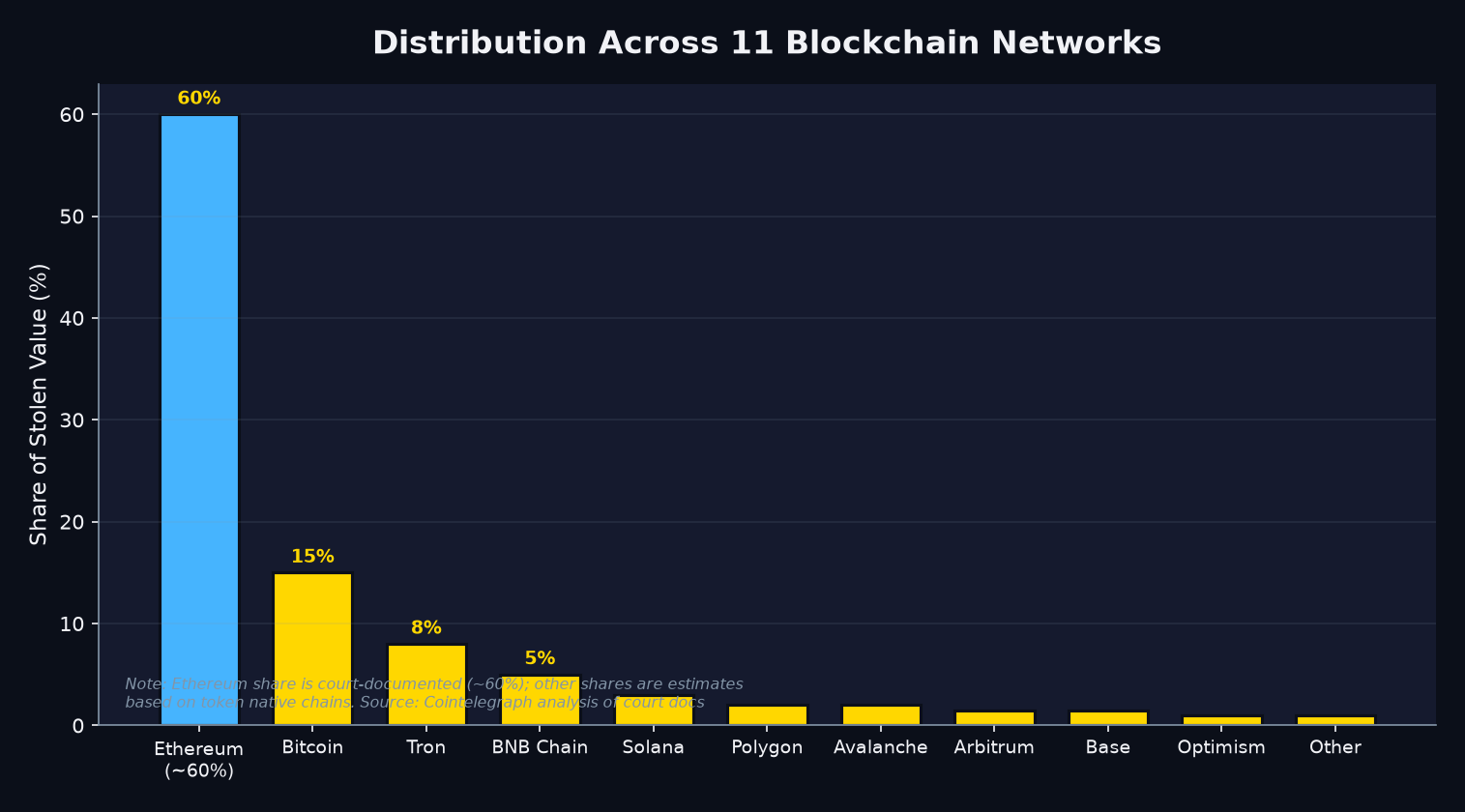
Ethereum’s dominance reflects its role as the primary settlement layer for stablecoins and DeFi tokens held on Binance.
The 11-network spread matters for recovery. Each chain has its own consensus rules, explorer infrastructure, and — critically — its own set of entities capable of freezing or blacklisting addresses. USDT on Tron can be frozen by Tether in coordination with Tron validators; USDT on Ethereum can be frozen at the smart-contract level; BTC has no freeze mechanism at all. This fragmentation is why the court ordered 18 different firms to maintain their existing freezes rather than relying on a single chokepoint.
Sources: Ethereum 60% share from Cointelegraph analysis of court documents. Cross-chain freeze mechanics documented in Chainalysis Binance breach report (October 2026). On-chain tracing visible via Lookonchain and Arkham Intelligence.Legal recovery timeline and next steps
The November 19 filing is the latest move in a fast-moving legal process that began within days of the October 29 hack. The Abu Dhabi Global Market Courts have taken the lead because ADGM is where Nest Clearing and Custody Limited is registered, giving the court jurisdiction over the wallet operator.
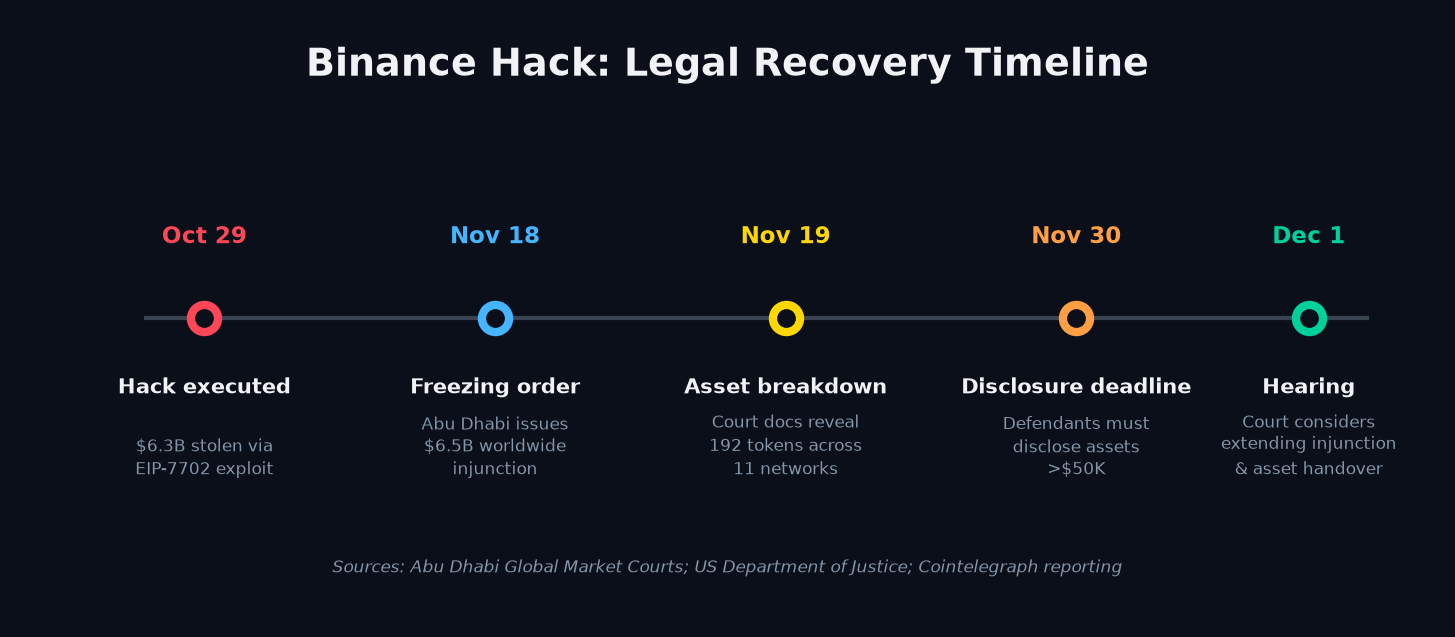
Legal recovery timeline from the October 29 hack through the December 1 injunction hearing.
On November 18, the court issued a $6.5 billion worldwide freezing injunction against the unidentified individuals accused of carrying out the attack. The order restricts them from dealing with assets up to that value and requires them to disclose worldwide assets worth more than $50,000 in sworn statements by November 30. A separate order requires 18 named firms — including Circle and BitGo Bank & Trust — to maintain existing freezes on assets linked to the hack.
The next major date is December 1, when the court will consider whether to extend the injunction and whether the 18 firms must hand over the assets they have frozen. For our earlier analysis of how this freezing order fits into the broader exchange security landscape, see our coverage of the Binance breach aftermath and exchange security rankings.
Sources: Abu Dhabi Global Market Courts freezing injunction dated November 18, 2026. Disclosure deadline and December 1 hearing from court order reported by Cointelegraph (Bryan O’Shea, Nov 18, 2026). The 18 named firms include Circle and BitGo Bank & Trust per the same filing.US DOJ recovery efforts
In parallel with the Abu Dhabi proceedings, the US Department of Justice said last Thursday it had obtained court authorization to seize or restrain more than $1.2 billion of the stolen cryptocurrency. This authorization covers part of the more than $2.7 billion in stolen assets that US authorities and private-sector partners have frozen since the October 29 hack.
Recovery scorecard as of November 19, 2026:
• Total stolen: $6.3 billion
• Frozen or restrained: $2.7 billion (43% of total)
• DOJ seizure authorization: $1.2 billion
• Abu Dhabi worldwide freezing injunction: $6.5 billion (covers full loss plus margin)
• Defendants’ asset disclosure deadline: November 30, 2026
• Next hearing: December 1, 2026
The $2.7B frozen figure is a recovery rate that would have been unthinkable in the pre-chain-analysis era. It reflects coordinated work between DOJ, private blockchain analytics firms, and the 18 financial institutions that held positions on the affected wallets. Investigators are still working to recover the remaining ~$3.6B, much of which is in BTC and other native assets that lack issuer-level freeze capabilities.
Sources: US DOJ court authorization reported by Cointelegraph. $2.7B frozen figure from DOJ statement and private-sector partner reports. Recovery rate methodology consistent with Chainalysis crypto crime tracking.What this means for exchange security
The 192-token, 11-network breakdown is more than a forensic curiosity. It carries three concrete implications for how exchanges and custodians will operate going forward:
1. Hot-wallet architecture must change. The fact that a single compromise could sign for 192 token types across 11 chains means the attack surface of consolidated hot wallets is too large. Expect a shift toward per-chain, per-token-type isolated signing infrastructure — the model that exchange security rankings now weight heavily.
2. Stablecoin freeze capability is a recovery moat. 55% of the stolen value was in stablecoins, most of which have issuer-level freeze functions. This is why the recovery rate (43% frozen so far) is dramatically higher than in native-asset thefts. Expect exchanges to hold a larger share of reserves in freezable stablecoins and a smaller share in non-freezable native assets — a trade-off between recovery safety and ideological purity.
3. Multi-jurisdictional recovery is now standard. The simultaneous Abu Dhabi freezing order, US DOJ seizure authorization, and 18-firm freeze coordination show that large-scale crypto recovery is now a multi-jurisdictional law enforcement operation, not a single-court process. The December 1 hearing will be a test case for whether courts can compel frozen-asset handover across borders.
For ongoing coverage of how this case develops and what it means for exchange security standards, our original Binance $6.3B breach report and EIP-7702 vulnerability analysis provide the technical foundation.
Sources & References
- Nest Clearing and Custody Limited asset schedule, filed November 19, 2026 with Abu Dhabi Global Market Courts — primary source for all 192-token breakdown figures.
- Cointelegraph: “Binance hackers stole 192 tokens across 11 networks, court docs show” — Felix Ng, November 19, 2026. Staff editor Yohan Yun.
- Cointelegraph: “Binance says it obtained $6.5B worldwide freezing order after hack” — Bryan O’Shea, November 18, 2026.
- CoinDesk: Binance breach EIP-7702 technical report — October 29, 2026.
- Chainalysis: Binance breach October 2026 report — on-chain tracing and freeze mechanics.
- Cointelegraph: DOJ $1.2B seizure authorization — US Department of Justice statement.
- Etherscan and Basescan — on-chain contract address verification.
- Lookonchain and Arkham Intelligence — real-time on-chain tracing tools.
- Rekt Database — historical DeFi exploit comparison data.
- Internal references: Binance $6.3B security breach initial coverage, Binance breach aftermath and exchange security rankings, EIP-7702 emergency patch analysis.
Disclaimer: This article is for informational purposes only and does not constitute financial or investment advice. NewCoinsIntel received no compensation from any party mentioned in this article for this coverage. All figures are sourced from public court filings and on-chain data; readers are encouraged to verify independently. Token values are calculated at prices at the time of the October 29, 2026 theft and may differ from current market values.
Editorial note: This article is part of NewCoinsIntel’s ongoing coverage of the Binance October 2026 security breach. It is produced independently under our editorial policy and is not sponsored content.
